No products available yet
Stay tuned! More products will be shown here as they are added.
What is natural wine?
Wine is a product of man, so the very definition of 'natural wine' is itself ambiguous. In fact, there are no strict rules establishing what natural wine is, no bodies certifying its application, no official or unofficial 'stamps' (as in the case of biodynamic products). The ambiguity is also due to the fact that the common use of the word 'natural' implies quality and genuineness, which often have to be proven. At the root of much of this discourse and more than a few controversies is the fact that there is no unambiguous definition of 'natural wine'.
The selection you will find is the result of my tastings, I have avoided including wines with faults.
There are, on the other hand, several winegrowers' associations and several 'manifestos' with their flocks of followers and adherents, with many points in common between them.
The basis of natural wines is the working philosophy and conscience of the winegrower. Natural methods of making wine are not always reproducible and difficult to fit into a single protocol. They respond to artisanal skills specific to a given territory and vary according to pedoclimatic aspects that differ from area to area.
Podere Le Ripi
Francesco Illy and Sebastian Nasello / Montalcino
"The beauty, the distance from all that we call civilisation, the absence of modern architecture, the fragrances that pervade these hills all year round, the view deep down, to the east of Monticchiello, and Montepulciano, the prehistoric volcano of Monte Amiata to the south, the amphitheatre-like hills that protect Le Ripi to the west and north. All this, so wonderful, but also so uncontaminated."
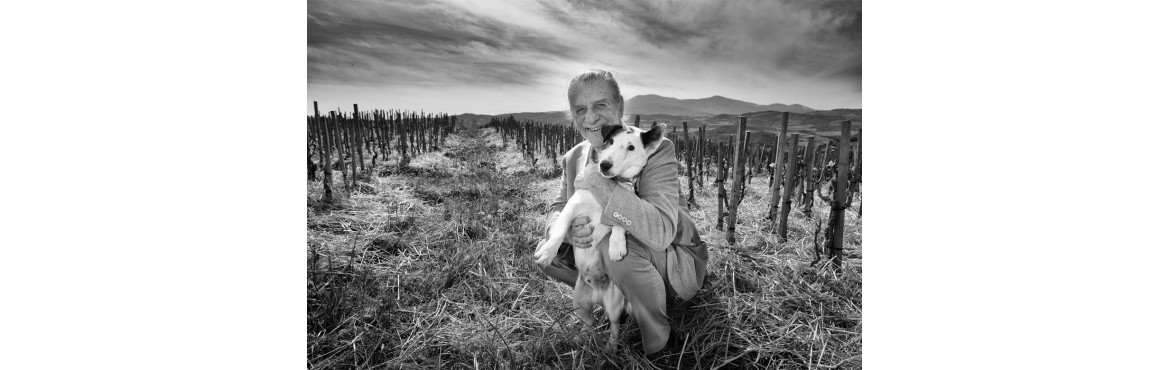
Podere le Ripi was born in Montalcino in 1984 from an initial falling in love by Francesco Illy, who bought the farm from a Sardinian shepherd near Castelnuovo dell'Abate, on the eastern side of Montalcino. It was the love that only a naturalist photographer can have for such an intense landscape. In 1999 he began his adventure in viticulture with the first plantings, and since 2011 he has been moving towards a biodynamic conversion.
Today the estate has about 31 hectares under vine, divided between the two slopes of Montalcino, one to the west with sandy alluvial soils rich in skeleton and the other to the east on calcareous marl with no skeleton; this is how the five different estate wines originate, each coming from individual plots, different in terroir and density. They start with plantings of 6,000 vines/ha, up to the Lupi and Sirene saplings of 11,100 vines/ha and the Bonsai vineyard of 62,500 vines/ha (the densest vineyard in the world).
All the wines undergo a slow and delicate accompaniment in the cellar, where large vats and barrels made of precious woods are used for both fermentation and ageing (from 24 to 36 months depending on the wines) and then finish with a harmonisation in cement. This whole process is aimed at exalting the classic nature of Sangiovese in Montalcino and the different facets of the vineyards. Deep roots, vines in full dialogue with their surroundings and the right amount of patience during ageing are the fundamental requisites for capturing the uniqueness that only Mother Nature can create.
Musella
Maddalena Pasqua di Bisceglie / San Martino Buon Albergo
Musella is a fortunate and marvellous historical estate at the gates of Verona in the direction of the Rising Sun. Its ancient history takes us back to the tales of the lives of men and women who, over the centuries, have populated these lands and woods full of the charm of yesteryear. It is the Pasqua family, with Emilio, Maddalena and Enrico, who have decided to immerse themselves in this peace, thinking of living here with respect and gratitude; biodynamics is in fact the perfect practice for this relationship of care and exchange with nature.
A paradise spread over 25 hectares of land where forests, streams and olive groves alternate with vineyards. The tangible presence of woodland animals, wild flowers and plants, and insects that proliferate thanks to the absence of heavy pollution, bring each other into balance, combined with the increasingly discreet and attentive practice of observation that leads them to be jealous custodians of their original integrity, leading to a lively and intense energy that is also found in the wines. For Maddalena, harmony must be everywhere, it can be explained through music or the smile of a person at peace with what and who surrounds them.
Here, the traditional vineyards of Corvina live on, giving in return a pure, bright, jovial, traditionally drinkable Valpolicella, as the Venetians like it, and also an austere Amarone that is relaxed and available, without constraint. The small toasted oak barrels gradually leave the cellar to make way for large oak barrels that are almost no longer toasted, various concrete containers, eggs, now also various marble containers (the red one from Verona). Authenticity and respect are the values that reflect Musella's wines, which are able to tell their terroir in a unique way.
La Stoppa
Elena Pantaleoni / Rivergaro
The La Stoppa winery is located in Rivergaro, in the Trebbia Valley, in the foothills of the province of Piacenza, in the north-western tip of Emilia-Romagna. In the second half of the 19th century, the lawyer Giancarlo Ageno discovered the wine vocation of this place and started a production of wines for long ageing, mostly from French vines. In 1973, the estate was purchased by Raffaele and Angela Pantaleoni. Since 1991, their daughter Elena has been running it, flanked by Giulio Armani, who has been with the company since 1980, and who has been joined by another 12 valuable employees over the years.
The estate consists of 58 hectares, 28 of which are woodland and the rest are vineyards. Farming is organic and all processing is done by hand by in-house staff. In the cellar, steel and cement tanks are used for fermentation, which takes place spontaneously, without the addition of sulphur dioxide and at room temperature. Long macerations are practised in order to extract everything possible from the grapes and to keep the characteristics of each vintage distinct. The long ageing in oak barrels is necessary for grapes grown on very old, iron-rich and nitrogen-poor red clay and allows the wine to mature slowly and naturally. Long ageing in the bottle is also necessary for the wine to find its balance and be a faithful expression of the terroir from which it comes.
Today, only a few labels are produced, all representative of the place; Trebbiolo, Barbera and Bonarda (from young vines), Macchiona (for a wine of great longevity), Ageno (the company's only dry white wine with long macerations), and finally Malvasia di Candia Aromatica. There is an ongoing wine production project in Chile, called Pisador, from Paìs grapes, over 100-year-old vines in the Maule valley, 400 km south of Santiago.
Lastly, I pay my customers fair prices, sometimes considered low for their dedication, commitment and time, but sufficient to pay their costs, make investments and continue with their business projects.
Culture is the only good of mankind that, divided among all, rather than diminishing, becomes greater. So wrote Hans-Georg Gadamer, the German philosopher. It is a concept that I put into practice every day, sharing what little I know with all those who want to listen, from visitors to the winery, to colleagues, to the interns we take every year at the grape harvest, to the Chilean winegrowers who have a treasure in their hands but no one has ever told them... but that is another story, at our latitudes but in another hemisphere...
Elena Pantaleoni
The winery is located in the municipality of Greve in the heart of Chianti (province of Florence) in the Italian region of Tuscany. The name (bella quercia) comes from the oak forests that grow luxuriantly here, which also provide protection from cross-contamination by conventional farms. The company was founded in 1974 by industrialist Giuseppe (Pepito) Castiglioni through the purchase of a vineyard with one hectare of vines. He set himself the goal of producing high quality wines 'that could stand alongside the best in the world'. In 1988, his son Sebastiano Cossia Castiglioni converted the vineyard management first to certified organic and then, in 2000, to biodynamic viticulture, without the use of pesticides (such as herbicides and fungicides) or other synthetic chemicals. Since no animal products are used during the production cycle from vineyard to bottle, the wines are certified vegan.
Stay tuned! More products will be shown here as they are added.
check_circle
check_circle